 FACEBOOK
 Google
The Rise of AI-Generated Children’s Books and Its Impact
Walk into any bookstore and you get a pretty clear sense of the effort that goes into a children’s book. The illustrations alone can take months. The story has to work on multiple levels at once, engaging enough for the child, meaningful enough for the adult reading it aloud. Getting it right is genuinely hard work.
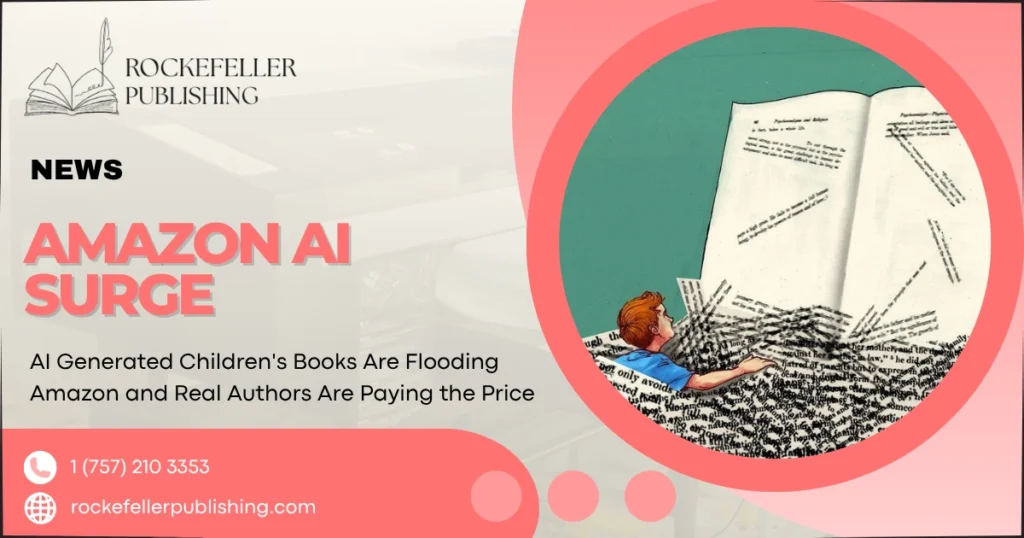
Now open Amazon and search for children’s books. What you find increasingly is something else entirely. Thousands of titles generated by AI tools in hours, uploaded in bulk, and priced to undercut the authors who spent real time and care on their work. The flood is real and it is getting worse.
What Is Actually Happening on Amazon Right Now
AI Tools Are Making It Too Easy to Publish Nothing
The figures are undeniable. More than 30 percent of all new titles published on Amazon KDP in 2026 contains a disclosure regarding AI use. This development is now prompting the industry to describe what’s happening on Amazon as a slush tsunami, consisting of poorly edited, zero-effort machine-generated output flooding authentic material.
Children’s books have become one of the most targeted categories. The reason is not complicated. Short text. Simple illustrations. Easy to generate. Easy to upload. And parents searching for new books for their kids have no immediate way of knowing what they are actually buying.
Some publishers are uploading three books per day, which is actually the maximum Amazon currently allows. Not three books per year. Three per day. Amazon put that cap in place specifically because the volume of AI uploads was becoming unmanageable, but even a daily limit of three still means a single operation can flood the market with over a thousand titles in a year.
What Readers End Up Getting
A parent picks up what looks like a sweet picture book about a child making friends. The cover looks professional enough. The description sounds fine. Then they sit down with their kid and realize the illustrations are slightly off in ways that are hard to describe, faces that do not quite look right, backgrounds that repeat in strange ways. The story has the right shape but nothing inside it that feels like it came from a real human experience.
Rolling Stone spoke with authors who described finding AI generated knockoffs of their own work on Amazon, close enough in title and concept to draw away sales, but with none of the craft that went into the original. The frustration is not just about money. It is about what happens to the platform and to readers when the signal gets buried under that much noise.
How Publishers and Authors Are Pushing Back
Amazon’s Disclosure Rule Is a Start But Not Enough
Amazon now requires anyone uploading AI generated content to KDP to check a disclosure box during the publishing process. The Authors Guild pushed hard for this policy and called it a welcome first step when it was introduced. But there is a catch that matters a lot. The disclosure is not shown to buyers. A reader browsing Amazon has no way of knowing from the listing itself whether a book was written and illustrated by a human or generated by software in twenty minutes.
The Authors Guild has specifically asked Amazon to extend disclosure requirements to what readers actually see, not just what publishers report during upload. That conversation is ongoing.
Major Publishers Are Drawing Clearer Lines
Penguin Random House and Macmillan have come out in opposition to the use of AI-generated materials in their editorial divisions. These major publishing houses, as among the biggest in the world, have now consciously taken a position about which books carry the Penguin and Macmillan brands.
For independent authors and smaller publishers watching from the outside, these decisions carry a message. The industry’s most established players are betting that human authorship still matters to readers and that protecting that distinction is worth drawing a firm line over.
What This Means for Children’s Book Authors Specifically
The Work You Put In Still Counts
Here’s what falls by the wayside when we talk about AI overwhelming everything. When a book helps forge an everlasting bond between author and reader, that book sprang from some place. If the person writing the child-rearing tips raised a child, wrestled with the experiences they are writing about, and dedicated their lives to thinking about young audiences, there is something to that that you and I can’t, or even don’t ever want to, reproduce with an AI.
The challenge right now is visibility. When thousands of AI generated titles appear every week in the same category as your book, standing out requires more than just writing something good.
Getting Your Book in Front of the Right Eyes
Authors navigating this landscape need more than a good manuscript. They need a cover design that immediately communicates quality. And they need metadata that works with Amazon’s search algorithm. They need a launch approach that generates early reviews from real readers. And they need a publisher or publishing partner who understands how the platform actually works in 2026, not how it worked three years ago.
At Rockefeller Publishing we work with authors across the United States who are serious about producing work that lasts. We help children’s book authors and authors in every genre bring their manuscripts to market in a way that gives their work a genuine chance to find the readers it deserves.
The AI flood is real. But so is the appetite for books that were made with real care.
Create a book that stands above AI generated content. Visit Rockefeller Publishing to get started.