 FACEBOOK
 Google

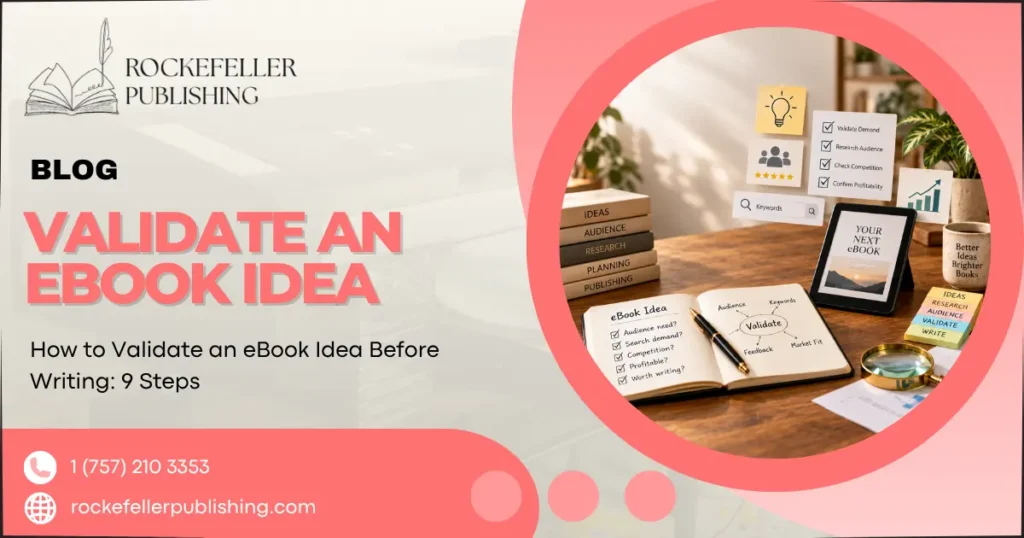
Knowing how to validate an eBook idea means gathering evidence that real readers have the problem your book solves, that they’re already searching for answers, and that there’s room for your angle in a crowded market. A good eBook idea may sound useful to you as the author, but that doesn’t automatically mean readers are searching for it, struggling with the problem, or willing to pay for a solution.
Validation happens before the full manuscript gets written, not after. The purpose is simple.
- Confirm your audience actually exists
- Understand the problem from the reader’s side
- Check whether demand already shows up in search behavior
- Study the competition instead of guessing about it
- Improve your positioning before you outline a single chapter
- Reduce the time you waste writing something nobody asked for
This guide walks through nine signals you can use to validate an eBook idea before writing, rather than relying on gut feeling alone. One honest note before we start. Validation reduces uncertainty. It cannot guarantee future sales. That distinction matters, because a validated idea still depends on good writing, smart positioning and a real marketing plan to succeed.
If you’re still shaping your concept, start with best eBook ideas for beginners before working through the steps below.
Key Takeaways
- An idea needs both reader relevance and evidence of demand to be worth pursuing.
- Existing competition can actually confirm that a market exists, rather than ruling out your idea.
- Search interest alone does not prove people are willing to pay for a book.
- Reader complaints on competing titles can reveal gaps nobody has filled yet.
- A clearly defined audience makes an eBook far easier to position and market.
- Small tests cost less than writing an entire manuscript on a hunch.
- A validated idea can still fail if the writing, design, pricing or marketing falls short.
What Does It Mean to Validate an eBook Idea?
Validating an eBook idea means collecting evidence that an audience exists, that they have a specific problem, that demand for a solution is visible somewhere, and that your angle adds something current options don’t. It is not the same as asking friends if your concept sounds interesting.
“Do you think this sounds like a good book?” is a weak question. A friend saying “great idea” doesn’t tell you whether a stranger would pay for it. Stronger evidence looks like this instead.
- Search behavior around the problem
- Competing books already selling in the space
- Reader reviews on those competing books
- Repeated questions from real people in forums or communities
- Email signups from people interested in the topic
- Direct interviews with potential readers
- Small content tests, like a blog post or guide
- Preorder or waitlist behavior
Why Validate Your eBook Before You Start Writing?
Validation exists for one practical reason. Writing a full manuscript takes real time, and that time is wasted if nobody wants the result.
It Reduces Wasted Writing Time
Writing an entire manuscript before discovering weak demand creates unnecessary risk. Spending a few weeks on research up front is far cheaper than spending months writing a book that doesn’t sell.
It Helps Define the Right Reader
A narrow audience is easier to understand and market to than “everyone.” Trying to write for every possible reader usually means connecting with none of them.
It Improves the Book’s Promise
Research often reveals that the original idea was too broad. For example, a book pitched as a general “Productivity Guide” is weaker than one positioned as “Productivity for Freelancers Managing Multiple Clients.” The second version tells a specific reader exactly why the book is for them.
It Can Reveal What Readers Actually Want
What an author wants to teach and what readers actually need aren’t always the same thing. Validation closes that gap before it becomes a finished book nobody asked for.
Step 1. Define the Exact Reader Before Testing the Idea
eBook audience research should start with the reader, not with tools or spreadsheets. Before testing anything, answer these questions honestly.
- Who is this eBook actually for?
- What stage of their journey are they at?
- What specific problem do they have right now?
- What have they already tried that didn’t work?
- What outcome are they trying to reach?
- Why would they need a book instead of free content online?
A simple formula helps turn a vague idea into a testable one.
Reader + Problem + Desired Outcome = Initial eBook Concept
For example, “Freelancers struggling with an inconsistent client pipeline who want predictable lead generation” is a far stronger starting point than “An eBook about freelancing.” Nailing down your eBook target audience this early makes every later step of eBook idea validation easier to run.
Step 2. Check Whether People Are Searching for the Problem
Once the reader is defined, move into eBook market research. Several free signals show whether people are already searching for answers related to your topic.
- Google search suggestions
- People Also Ask boxes
- Related searches at the bottom of results pages
- Google Trends
- YouTube search suggestions
- Reddit and community discussions
Use Google Trends for Direction, Not Sales Predictions
Google Trends is useful for comparing and exploring search interest over time, but it should never be treated as a forecast of how many people will buy an eBook. Google itself describes Trends as a tool for exploring search interest and trending searches, not purchase intent.
When using Google Trends for eBook ideas, look for these patterns.
- Sustained interest over time rather than a short spike
- Seasonal patterns that affect when to launch
- Declining interest, which can signal a shrinking topic
- Geographic differences across regions
- Alternative terminology readers use for the same problem
Search demand confirms interest in a topic. It does not necessarily confirm willingness to purchase a book about it. Keeping that distinction in mind is one of the simplest ways to avoid false confidence at this stage.
Step 3. Research Similar eBooks Already Being Sold
Next, look at real marketplaces where eBooks are actually bought.
- Amazon Kindle Store
- Apple Books
- Google Play Books
- Kobo
Amazon is usually the most useful place to focus your eBook competition research, since it holds the largest share of eBook buyers. While researching, check the following for each competing title.
- Titles and subtitles
- Positioning and promises made on the sales page
- Cover design
- Pricing
- Categories used
- Reader reviews
- Publishing dates
- Available formats
- Audience the book claims to serve
Competition is not automatically a bad sign. Zero competitors in a space could mean one of two things. Either it’s an untapped opportunity, or there’s no meaningful demand at all. The goal of this step isn’t finding a topic nobody has written about. The goal is finding existing demand paired with room for a better or more specific solution.
Step 4. Analyze Amazon Categories Without Chasing “Easy” Categories
Amazon officially explains that categories help place books on relevant digital shelves, and the platform advises authors to balance popularity and relevance rather than choosing unrelated categories to appear more visible. Review the Amazon KDP categories guide for the full rules before publishing.
While researching Amazon KDP categories for your concept, study these details.
- Which categories competing books currently use
- Whether your own concept genuinely fits those categories
- How broad or narrow the surrounding market appears
- Adjacent subcategories that might fit better
Don’t pick irrelevant low-competition categories just because they look like an easy shortcut. Amazon explicitly warns against inaccurate categorization, and miscategorized books tend to underperform because they reach the wrong readers entirely.
Step 5. Read Competitor Reviews to Find Unmet Reader Needs
This step tends to produce the most useful insight in the entire process, so don’t rush it. Counting star ratings isn’t enough. Reading the actual reviews is where the real information lives.
Look for recurring comments such as these.
- Too basic for the topic
- Too advanced for a beginner audience
- Outdated information
- Missing practical examples
- Not actionable enough
- Poor organization
- No templates or worksheets included
- Too much theory, not enough application
- Didn’t address a specific type of reader
- Too broad to be genuinely useful
Validation approaches commonly recommend mining competitor reviews because complaints expose exactly which gaps readers still want solved.
Turn Complaints Into Better Positioning
Suppose a reviewer writes “useful information, but nothing specifically for beginners”; that single complaint points directly to an opportunity. The same core problem paired with a beginner-specific solution could become your book’s entire angle. The purpose here isn’t copying competing books. It’s identifying a need those books left unmet.
Step 6. Search for Questions Real Readers Keep Asking
Move beyond marketplaces and look at where people discuss the problem in their own words.
- Reddit threads
- Quora questions
- Facebook groups
- Niche forums
- YouTube comment sections
- LinkedIn communities, where relevant
- Customer emails, if you already have an audience
A single person asking a question is interesting but not conclusive. Many unrelated people asking variations of the same question is much stronger evidence of a real, shared problem.
Create a Question Bank
Recording what you find in a simple table makes the research usable later.
| Reader Question | Frequency | Current Solutions | Potential Book Section |
| Problem A | High | Weak | Chapter opportunity |
| Problem B | Medium | Strong | Lower priority |
| Problem C | High | Incomplete | Strong opportunity |
This single habit makes your research far more actionable than most generic competitor-watching advice.
Step 7. Identify the Gap Your eBook Will Own
With research from the earlier steps in hand, start combining the evidence into a clear direction.
- Is the existing content too broad? Narrow your angle.
- Is it too advanced? Build a beginner-friendly version instead.
- Is it mostly theoretical? Make yours actionable with steps and templates.
- Is the information scattered across many sources? Build one structured guide.
- Is the market outdated? Offer updated, current material.
- Is one audience underserved? Build specifically for them.
A simple formula captures the goal of this step.
Existing demand + underserved need + clear audience + distinct outcome = stronger eBook positioning
Step 8. Test the Idea With Real People Before Writing the Full Book
At this point, shift from passive research into active testing. Several lightweight formats work well.
- Email survey
- Audience poll
- Short one-on-one interview
- LinkedIn post
- Blog article on the topic
- Newsletter mention
- Social media post
- Downloadable checklist
- Free mini-guide
- Webinar or workshop
Avoid asking only “would you buy this?” because polite answers rarely predict real behavior. Behavioral questions produce far more honest, useful answers.
- When did you last face this problem?
- What did you do about it at the time?
- What information was hardest to find?
- Have you paid for a solution to this before?
- What was missing from that solution?
Behavior tells you more than opinions do, every time.
Step 9. Test the Offer Before Writing the Entire Manuscript
This is the strongest form of commercial validation available before you write a single chapter. Build a simple concept page or eBook landing page containing the following.
- Working title
- Subtitle
- Target reader description
- Main outcome the book delivers
- Four to six proposed chapter ideas
- Expected format
- Email signup or waitlist option
Watch for these signals once the page is live.
- Signup rate
- Replies to your outreach
- Follow-up questions from visitors
- Requests for release information
- Qualified interest from the right audience
- Preorders, where that’s possible for your setup
Landing pages, waitlists and small presales tend to produce far stronger evidence than hypothetical opinions collected informally. One caution worth repeating. Don’t apply arbitrary universal rules like “50 signups means your idea is validated.” Traffic quality, audience size and niche all differ wildly between authors. Compare your results against your own existing audience and goals instead of someone else’s numbers.
How to Know If Your eBook Idea Is Too Broad
A few warning signs usually show up when a concept needs narrowing.
- The target audience is described as “everyone”
- The title tries to cover an entire industry
- The book promises multiple unrelated outcomes
- Each proposed chapter could become its own separate book
- Competitor results span many unrelated reader groups
Narrowing the idea often makes it dramatically stronger. “Marketing” becomes “Email Marketing for Freelance Designers.” “Personal Finance” becomes “First-Year Budgeting for New College Graduates.” The narrower version is easier to position, easier to market, and easier for the right reader to recognize as written for them.
What If Your eBook Idea Has a Lot of Competition?
Heavy competition doesn’t automatically mean the idea should be rejected. It often means the opposite. Before walking away, ask the following.
- Is demand genuinely strong in this space?
- Can you target a narrower, more specific reader?
- Can you offer a different format or structure?
- Can you solve one piece of the problem better than anyone else?
- Are the competing books outdated?
- Do reviews reveal weaknesses you could fix?
A competitive category can actually indicate healthy demand. What matters most is whether there’s genuine space for your positioning inside it.
What If You Find Almost No Competition?
Low or missing competition usually points to one of three situations.
- An early or emerging market
- A highly specialized niche
- Weak or nonexistent commercial demand
Before assuming you’ve found a hidden goldmine, run additional validation.
- Reader interviews
- Search behavior research
- Community question digging
- A landing page test
Don’t automatically label a low-competition topic as profitable. Sometimes low competition means low demand, and the only way to tell the difference is more direct testing.
Common eBook Validation Mistakes
Choosing a Topic Only Because You Like It
Author interest matters for motivation, but it isn’t demand evidence on its own.
Treating Search Volume as Buyer Intent
Searches can be purely informational. People searching for information aren’t automatically ready to buy a book about it.
Looking Only at Bestsellers
Mid-level competitors often reveal more realistic opportunities than the top-ranked titles in a category.
Copying Competitors
Validation should reveal opportunities to improve on what exists, not encourage straight imitation of it.
Asking Friends and Family
People close to you may not represent your actual reader or give you honest feedback.
Changing the Idea After Every Piece of Feedback
Look for patterns across many responses rather than reacting to a single isolated opinion.
Assuming Low Competition Means Easy Sales
Sometimes low competition reflects low demand rather than an open opportunity.
When Should You Stop Validating and Start Writing?
Validation can become a form of procrastination if it drags on indefinitely. Move forward once you can confidently answer these questions.
- Who is this book for?
- What problem does it solve?
- What evidence shows that problem actually exists?
- Are people already consuming or purchasing related solutions?
- What will your book do differently?
- Can you realistically reach your target audience?
Once those answers feel reasonably clear, it’s time to move forward. Outline, write, edit, then publish.
What Comes After Your eBook Idea Passes Validation?
Once your concept has solid evidence behind it, the next steps follow a fairly predictable sequence.
- Build the outline
- Define each chapter’s intended outcome
- Write the first draft
- Edit the manuscript
- Format the book
- Choose a publishing platform
- Optimize metadata
- Launch and market the book
For the first step beyond validation, see how to turn an idea into a professionally published book. When you’re ready for the final stage, how to publish an eBook on Amazon walks through the full process.
Final Takeaway. Validate the Problem Before You Write the Solution
You don’t need absolute certainty before writing an eBook. You need enough evidence to know who the reader is, what problem they care about, whether demand exists, and why your book deserves a place alongside current alternatives.
Research first. Validate second. Write third.
Frequently Asked Questions
How do I validate an eBook idea before writing?
Define your exact reader, check search demand, study competing books, read their reviews for gaps, and test your concept with a small audience before writing the full manuscript.
How do I know if my eBook idea will sell?
No method guarantees sales, but strong signals include repeated reader complaints about existing books, consistent search interest, and real engagement when you test the concept with a landing page or survey.
How much competition is too much for an eBook idea?
There’s no fixed number. Heavy competition often confirms demand exists. Focus instead on whether you can offer a narrower audience, a different format, or a clearer solution than what’s already available.
Can I validate an eBook idea using Google Trends?
Google Trends is useful for spotting search interest patterns over time, but it should not be used to predict how many copies a book will sell. Use it for direction, not forecasting.
How do I research an eBook niche?
Combine search behavior research, marketplace analysis on sites like Amazon, and community discussions on platforms like Reddit or Quora to understand what a niche audience is already asking for.
Should I use Amazon to validate an eBook idea?
Yes. Amazon shows real competing titles, their pricing, their categories, and their reviews, all of which reveal whether demand exists and where the gaps are.
What if there are no books similar to my eBook idea?
This could mean an early market opportunity, or it could mean low demand. Run additional validation, such as reader interviews and a landing page test, before assuming it’s an open opportunity.
Should I ask people if they would buy my eBook?
Direct yes or no questions tend to produce overly polite, unreliable answers. Behavioral questions about past actions and spending tend to reveal more honest intent.
How long should I spend validating an eBook idea?
There’s no universal timeline. Spend enough time to confidently answer who the book is for, what problem it solves, and what evidence supports demand, without letting research turn into permanent delay.
Can a validated eBook idea still fail?
Yes. Validation reduces uncertainty around demand, but it doesn’t control writing quality, cover design, pricing, distribution, or marketing execution after publication.