 FACEBOOK
 Google
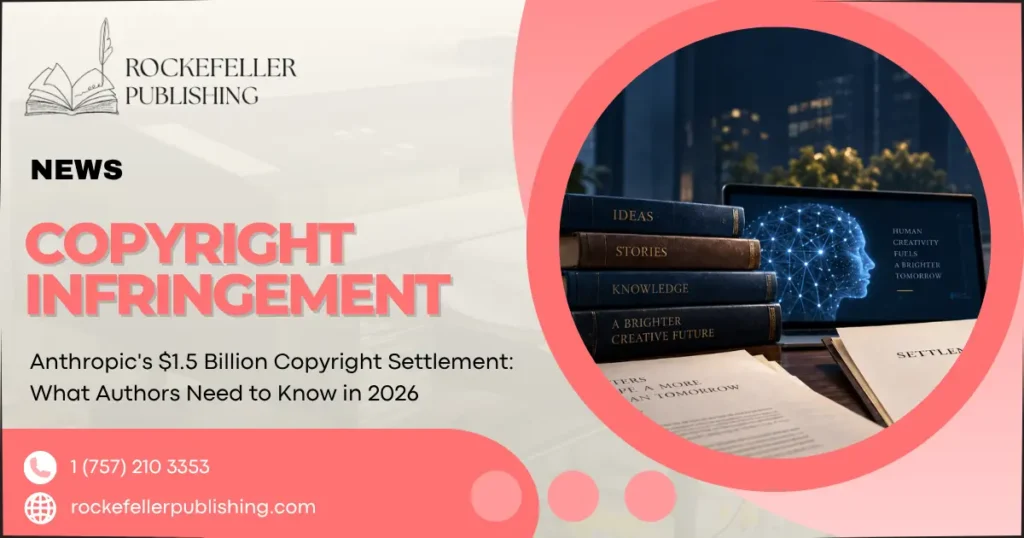
Anthropic’s $1.5 billion copyright settlement resolves claims that the company acquired millions of pirated books to train its Claude AI models. The claim deadline passed on March 30, 2026, and claimants are now reviewing ownership allocations between authors and publishers. Estimated payments are around $3,000 per qualifying work, though final amounts depend on rights-holder allocation and administrative costs.
Key Takeaways
- Anthropic agreed to a $1.5 billion copyright settlement.
- The standard deadline to file a claim has already passed.
- Claimants are now reviewing ownership and payment allocations.
- Around 440,490 eligible works had been claimed as of the reported April 2026 update.
- Estimated compensation has been around $3,000 per qualifying work, before individual rights-holder allocation and subject to final distribution calculations.
- The court distinguished AI training fair use from the separate acquisition and retention of pirated books.
- Authors should review copyright registrations, publishing contracts, and ownership records.
Anthropic’s $1.5 billion copyright settlement has moved into an important new stage for authors and publishers who filed claims over books included in the case. Claimants are now reviewing ownership allocations, including situations where both authors and publishers have requested a share of payments.
This isn’t simply a case about whether artificial intelligence can learn from books. The legal dispute also involved millions of books Anthropic obtained from pirate libraries while developing its Claude AI models. The settlement received final court approval in July 2026. For authors, that approval marks the beginning of a new phase, not the end of the story.
What Is the Anthropic Copyright Settlement?
The Anthropic copyright settlement stems from Bartz v. Anthropic PBC, a lawsuit brought by authors Andrea Bartz, Charles Graeber, and Kirk Wallace Johnson. The three writers challenged Anthropic’s acquisition and use of copyrighted books while developing its AI models.
Anthropic is an AI company best known for Claude, a large language model trained on vast amounts of text. Like other AI developers, Anthropic needed enormous quantities of written material to train Claude, and the source of some of that material became the central issue in this case.
Why Is the Settlement Worth $1.5 Billion?
The scale of the Anthropic copyright lawsuit explains the size of the payout. Anthropic downloaded millions of book files from pirate sources, including LibGen and PiLiMi. According to the official settlement website, roughly 7 million files from those sources were produced as evidence during the case.
A crucial legal distinction: The court did not rule that using books to train Claude was itself copyright infringement. Judge William Alsup found that the specific training use at issue was transformative and protected under fair use. However, he treated the acquisition and retention of pirated copies separately, and he rejected fair-use protection for those pirated library copies. This single distinction is more accurate than much of the reporting surrounding the case, and it matters for anyone trying to understand what this Anthropic authors settlement does and does not decide.
Where the Anthropic Settlement Stands Now
The Claim Deadline Has Already Passed
If you’re searching for information on how to file a claim, that window has closed. March 30, 2026, was the claim deadline, and the official settlement website confirms that the filing period has ended. Authors researching the Anthropic settlement claims process today are past the submission stage and into the review stage.
Authors Are Now Reviewing Claim Allocations
The current news hook isn’t filing; it’s reconciliation. The settlement administrator has sent claim summaries showing claimed titles, other rightsholders claiming the same book, requested percentages, and payment or contact information. The Authors Guild has explained that claimants may need to confirm or update allocation details as part of this Anthropic settlement payment process.
How Many Books Were Claimed?
The participation numbers in this Anthropic copyright lawsuit are unusually high for a class-action settlement.
- Eligible works: 482,460
- Claimed works: 440,490
- Claim rate: approximately 91.3%
- Settlement fund: $1.5 billion
The Authors Guild reported that 440,490 of 482,460 eligible works had been claimed by April 2026. That participation rate suggests widespread awareness among authors and publishers about the scope of the case, even before individual payment amounts were finalized.
How Much Could Authors Receive From the Anthropic Settlement?
This is one of the most searched questions related to the case, and it deserves a careful answer. The estimated amount has generally been described as around $3,000 per qualifying work. That figure does not necessarily mean an individual author receives $3,000, because the amount may be divided among multiple copyright rightsholders tied to the same book.
Why the Final Amount May Differ
Several factors can shift the final Anthropic settlement payment away from any early estimate:
- Legal fees
- Administrative costs
- The number of valid claimed works
- Settlement-fund interest
- Rights-holder allocation
- Multiple authors or publishers sharing one title
Earlier Authors Guild calculations estimated a base distribution around $2,931 per claimed work, based on the assumptions available at that stage. Treat every figure connected to this case as an estimate, not a guaranteed payout.
Why an Author May Have to Share the Settlement Payment With a Publisher
For many traditional trade and university press titles, the settlement claims system provides a default split: 50% to the author side and 50% to the publisher side, when that default applies and both parties use it. Publishing contracts can change this outcome, so the specific terms of an author’s agreement matter more than any general rule.
What Happens When More Than One Author Owns Rights?
If the author side receives 50% of a payment but two co-authors share that portion, their individual shares may be further divided. There is no single universal formula here. Each case depends on the contract and the claim as filed.
What If the Author Is the Sole Copyright Owner?
A self-published author who owns the relevant exclusive rights may be treated as the sole owner and potentially entitled to the full work-level allocation, subject to the settlement’s rules and a valid claim. This distinction is especially relevant for independent writers who never signed a traditional publishing contract.
Why Self-Published Authors Should Pay Attention
This settlement exposes something that goes beyond any single lawsuit: the importance of copyright ownership, copyright registration, ISBN and publishing records, publishing contracts, rights reversions, file ownership, distribution accounts, and documentation.
Self-publishing gives authors significant control, but that control only helps when authors understand and document ownership properly. Authors preparing to publish should think carefully about understanding publishing rights on Amazon KDP from the very start, since control over files, accounts, and rights becomes far more important once outside parties, including AI companies, start using published material.
Copyright Registration Became a Major Issue in the Anthropic Case
The Authors Guild reported that some writers discovered their publishers had apparently failed to register eligible books with the U.S. Copyright Office, even where authors believed registration was required under their agreements. For the settlement class, eligibility depended on specific requirements, including copyright-registration timing.
It would be misleading to say every book must be registered with the U.S. Copyright Office to have copyright. Copyright generally exists as soon as a qualifying original work is fixed in a tangible medium. U.S. registration, however, can provide important procedural and enforcement benefits, and it was specifically important under this settlement’s eligibility rules.
What Authors Can Learn From the Anthropic Settlement
Keep Clear Records of Copyright Ownership
Save contracts, registrations, rights reversions, ISBN records, and publishing agreements together, and keep them updated as circumstances change.
Know Which Rights You Have Licensed
Authors should understand whether a publishing agreement covers reproduction, digital rights, audiobook rights, translation, licensing, derivative rights, or enforcement proceeds. Not all contracts use identical terms, so read the specific language in each agreement.
Check Who Controls Your Publishing Accounts
This is especially useful for indie authors. Know who owns your KDP account, IngramSpark account, ISBN, manuscript files, metadata, cover files, and royalty accounts. Amazon KDP royalties for self-published authors depend heavily on maintaining clear control over these accounts.
Keep Your Original Manuscript and Production Files
Store drafts, notes, research files, and editing records. These become valuable evidence of ownership and originality if a dispute ever arises.
Review Copyright Registration After Publication
Don’t assume someone else handled registration on your behalf. This lesson ties directly to what the Anthropic case revealed about gaps between what authors believed and what publishers actually filed.
Does the Anthropic Settlement Mean AI Cannot Train on Copyrighted Books?
No, not based on this ruling alone. Judge Alsup ruled that the training use presented in Bartz v. Anthropic was fair, while separately finding that Anthropic’s acquisition and retention of pirated library copies was not excused as fair use. Other cases involving AI and copyright continue independently, and none of them are automatically decided by this outcome.
What Does the Settlement Mean for AI Copyright Cases?
This AI copyright settlement broadens a conversation that extends well beyond Anthropic. AI developers, authors, publishers, and licensing bodies are all working through questions about piracy, training data provenance, and compensation models.
Copyright disputes involving AI companies remain active elsewhere. For example, the Authors Guild and other plaintiffs continued copyright litigation involving OpenAI and Microsoft in September 2026. This settlement does not automatically resolve those cases. It also isn’t the only recent example of the industry pushing back on unauthorized book use; publishers taking legal action against pirated book platforms have pursued similar arguments about stolen content feeding AI development.
Could AI Companies Eventually License More Books?
The publishing industry’s bigger question may become less about whether AI can learn from books, and increasingly about where those books came from, who owned them, and whether permission or compensation was required.
Industry discussion has pointed toward several possibilities, including direct licensing, collective licensing, publisher agreements, author opt-ins, dataset transparency, and new compensation mechanisms. These remain industry possibilities, not confirmed outcomes tied to the Anthropic settlement itself.
Watch Out for Fake Anthropic Settlement Emails
The Authors Guild has specifically warned that scammers have used settlement-related messages and look-alike domains to target authors. Verify any communication against the official settlement administrator before responding. Don’t click unexpected settlement links, and don’t share personal or financial information based on urgency alone.
This pattern echoes other schemes that have targeted writers, including U.S. Copyright Office email scams targeting authors. Whether the message claims to come from a court settlement or a federal agency, the same rule applies: verify independently before you act.
What Should Authors Who Already Filed a Claim Do Now?
If you already submitted a claim, the current phase is about review, not new submissions. Authors in this position should:
- Check the official claim summary
- Review titles listed under their name
- Verify allocation percentages
- Check payment and contact details
- Review competing rightsholder claims
- Retain publishing agreements
- Keep supporting documentation
- Use the official settlement portal
- Seek qualified legal advice for contract disputes
The official allocation portal explains the current review process in detail. Rockefeller Publishing is not providing legal advice here; authors with contract-specific questions should consult a qualified copyright attorney.
What If an Author Did Not File Before the Deadline?
The standard claim deadline has passed, and this article cannot offer false hope that a normal claim can still be submitted. Authors in this situation should refer to the official settlement administrator for authoritative, case-specific guidance rather than relying on secondhand summaries.
What This Means for the Future of Author Rights
Three lessons stand out beyond the headlines.
Provenance matters. Where AI companies obtain training material can carry separate legal consequences, distinct from whether the training use itself is fair.
Copyright records matter. Authors need to know how their rights are documented, not just assume registration happened automatically.
Publishing agreements matter. A single book can have several economic stakeholders even when one person wrote it, which is exactly why allocation disputes have emerged in this case.
Final Takeaway for Authors
The Anthropic settlement isn’t simply a headline about AI paying authors $1.5 billion. It highlights something more practical: authors need to know who owns their rights, whether their work is properly registered, where their files are distributed, and what their publishing contracts say about infringement proceeds.
Authors preparing to publish should establish ownership, publishing accounts, distribution records, and rights documentation from the start independent publishing support can help authors build that foundation before problems like this one ever arise.
This article provides publishing-industry information and does not constitute legal advice. Authors with questions about contractual ownership or settlement allocations should consult the official settlement administrator or a qualified copyright attorney.
Frequently Asked Questions
What is the Anthropic copyright settlement?
It’s a $1.5 billion settlement resolving Bartz v. Anthropic PBC, a lawsuit over Anthropic’s acquisition of millions of pirated books used while developing its Claude AI models.
How much is the Anthropic copyright settlement worth?
The settlement fund totals $1.5 billion, covering eligible claimed works from authors and publishers.
How much could authors receive per book?
Estimates have generally pointed to around $3,000 per qualifying work. However, the final amount depends on rights-holder allocation, legal fees, and administrative costs.
Is the Anthropic settlement claim deadline still open?
No. The standard claim deadline was March 30, 2026, and that filing window has closed.
Does the Anthropic settlement include self-published authors?
Yes, self-published authors who hold the relevant copyright and filed a valid claim can be treated as sole owners of their work-level allocation, subject to the settlement’s rules.
Did the court rule that AI training on books is illegal?
No. Judge Alsup found the specific training use in this case to be fair use, while separately ruling that acquiring and retaining pirated copies was not protected.
Why might publishers receive part of the settlement?
Many trade and university press contracts include a default 50/50 split between author and publisher sides when that default applies to the claim.
When will Anthropic settlement payments be made?
No fixed universal payment date has been formally announced. The settlement agreement includes funding installments extending into 2027, and timing may vary by claim.